
|
Astronomy Picture Of the Day (APOD)
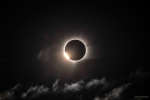 APOD: 2026 August 14 Б Total Solar Eclipse from Greenland
14.08.2026
On August 12, the Moon's shadow reached out to touch our fair planet. Beginning in the Arctic Ocean, it swept along a narrow track that led the dark lunar umbra across parts of Greenland, Iceland, the Atlantic, Portugal, and northern Spain.
 APOD: 2026 August 13 Б Total Solar Eclipse Over Spain
13.08.2026
On August 12th, 2026, the Moon totally eclipsed the Sun and cast its shadow across Siberia, Greenland, Iceland, Spain, and Portugal. TodayБs image features two total solar eclipses viewed from Zaragoza, Spain, one over the Cathedral-Basilica of Our Lady of the Pillar and the other reflecting in the Ebro River.
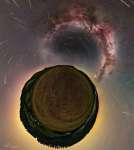 Perseids Over a Little Planet
12.08.2026
It looks like a view from the Little Prince's planet. The featured image is a throwback to the 2024 Perseid meteor shower, surrounded in this projection by the Bieszczady Mountains in Poland. Visible...
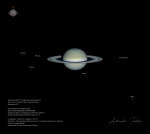 APOD: 2026 August 11 Б Six Moons of Saturn
11.08.2026
How many moons does Saturn have? While the total will likely continue to grow, as of June 2026 the ringed gas giant had 293 confirmed moons. That's easily more than any other planet of the Solar System, including ruling gas giant Jupiter with a mere 115 confirmed moons.
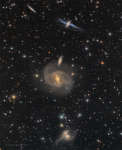 APOD: 2026 August 10 Б Three Galaxy Pairs
10.08.2026
Each of these pairs of galaxies is different. The two galaxies at the top are likely not interacting, at least presently. However, the top galaxy with the blue stripe, NGC 4650A, is a polar ring galaxy and may be the result of a past galaxy collision.
 APOD: 2026 August 9 Б Contemplating the Sun
9.08.2026
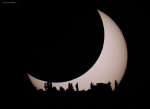
Have you contemplated your home star recently? Featured here, a Sun partially eclipsed on the top left by the Moon is also seen eclipsed by earthlings contemplating the eclipse below. This spectacular menagerie...
 APOD: 2026 August 8 Б A Messier Moment for Tempel 2
8.08.2026
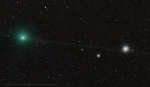
Which of these is not a comet? You guessed it - the one on the right is a globular star cluster. The diffuse greenish coma of periodic comet 10P/Tempel 2 is at left in the frame.
 Rubin's COSMOS Field
7.08.2026
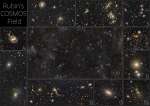
There are more than half a million galaxies in the central panel of this image from the NSF-DOE Vera C. Rubin Observatory in Chile. This is the COSMOS field, a patch of sky several times larger than the full moon, first observed by Hubble.
 APOD: 2026 August 6 Б New Sharpest Image of the Sun Uncovers Instability
6.08.2026
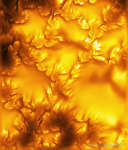
What does the new sharpest image of our Sun show? Instability. To be clear, a certain kind of interactive process called the Kelvin-Helmholtz instability (KHI). This instability can create waves and swirls when two streams flow past each other -- in this case variable streams of solar magnetic plasma.
 APOD: 2026 August 5 Б Spokes on Saturn's B Ring
5.08.2026
DonБt get spooked by SaturnБs ghostly spokes! Today we feature a nearly two-hour timelapse of Saturn and its rings looping forwards and backwards. A day on Saturn is only 10 hours long, so two hours of observation covers quite a bit of its rotation.
|
January February March April May June July August |
||||||||||||||||||||||||||||||||||||||||||||||||||||||||