Рейтинг публикаций
|
На данной неделе 13 сентября Луна (Ф= 0,4+) пройдет севернее Антареса. 14 сентября Меркурий достигнет максимальной восточной (вечерней) элонгации 27 градусов, а Нептун вступит в противостояние с Солнцем Оценка: 5.0 [голосов: 1]
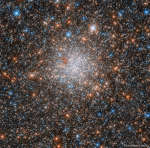
Jewels don't shine this bright -- only stars do. And almost every spot in this jewel-box of an image from the Hubble Space Telescope is a star. Now, some stars are more red than our Sun, and some more blue -- but all of them are much farther away. Оценка: 5.0 [голосов: 1]
На данной неделе 9 мая Луна (Ф= 0,85-) проходит точку максимального склонения к югу от небесного экватора, а Уран вступит в соединение с Солнцем Оценка: 5.0 [голосов: 1]
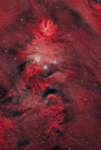
A star forming region cataloged as NGC 2264, this beautiful but complex arrangement of interstellar gas and dust is about 2,700 light-years distant in the faint but fanciful constellation Monoceros, the Unicorn. Seen... Оценка: 5.0 [голосов: 1]
На картинке показаны все цвета, излучаемые Солнцем в видимом свете. Этот свет прошел через прибор, подобный призме. Спектр был получен в Солнечной обсерватории МакМата-Пирса. Спектр демонстрирует, что наше желтое Солнце излучает свет абсолютно всех цветов, хотя, конечно, ярче в желто-зеленой части спектра. Оценка: 5.0 [голосов: 1]
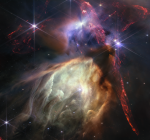
A mere 390 light-years away, Sun-like stars and future planetary systems are forming in the Rho Ophiuchi molecular cloud complex, the closest star-forming region to our fair planet. The James Webb Space Telescope's NIRCam peered into the nearby natal chaos to capture this infrared image at an inspiring scale. Оценка: 5.0 [голосов: 1]
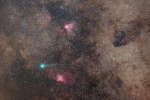
Comet C/2025 R2 (SWAN) sports a greenish coma and fainter tail, seen against congeries of stars and dusty interstellar clouds in this 7 degree wide telescopic field of view from October 17. On that... Оценка: 5.0 [голосов: 1]
Очередной выпуск ежемесячника, освещающего астрономические явления и небесные тела, доступные для наблюдений невооруженным глазом и любительскими оптическими средствами Оценка: 5.0 [голосов: 1]
What electrifies the Heart Nebula? First, the large emission nebula on the left, catalogued as IC 1805, looks somewhat like a human heart. The nebula glows brightly in red light emitted by its most prominent element, hydrogen, but this long-exposure image was also blended with light emitted by sulfur (yellow) and oxygen (blue). Оценка: 5.0 [голосов: 1]
Очередной выпуск журнала для любителей астрономии "Небосвод" Оценка: 5.0 [голосов: 1] |
|