Рейтинг публикаций
|
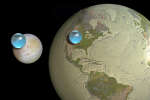
How much of Jupiter's moon Europa is made of water? No one is sure, but probably a lot. Based on the Galileo probe data acquired during its exploration of the Jovian system from 1995 to 2003, Europa possesses a deep, global ocean of liquid water beneath a layer of surface ice. Оценка: 5.0 [голосов: 1]
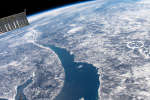
Orbiting 400 kilometers above Quebec, Canada, planet Earth, the International Space Station Expedition 59 crew captured this snapshot of the broad St. Lawrence River and curiously circular Lake Manicouagan on April 11, 2019. Right of center, the ring-shaped lake is a modern reservoir within the eroded remnant of an ancient 100 kilometer diameter impact crater. Оценка: 5.0 [голосов: 1]
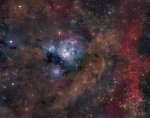
Young suns still lie within dusty NGC 7129, some 3,000 light-years away toward the royal constellation Cepheus. While these stars are at a relatively tender age, only a few million years old, it is likely that our own Sun formed in a similar stellar nursery around five billion years ago. Оценка: 5.0 [голосов: 1]
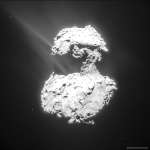
Where do comet tails come from? There are usually no obvious places on the nuclei of comets from which the jets that create comet tails emanate. One of the best images of emerging jets... Оценка: 5.0 [голосов: 1]
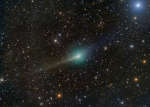
Attention grabbing interstellar visitor 3I/ATLAS made its not-so-close flyby of our fair planet on December 19 at a distance of 1.8 astronomical units. That's about 900 light-seconds. This deep exposure captures the comet... Оценка: 5.0 [голосов: 1]
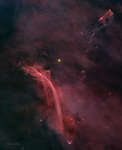
What created the Waterfall Nebula? The origin is still being researched. The structure, officially designated Herbig-Haro 222, appears in the region of NGC 1999 in the Great Orion Molecular Cloud complex. The elongated gaseous stream stretches about ten light years but appears similar to a long waterfall on Earth. Оценка: 5.0 [голосов: 1]
Оценка: 5.0 [голосов: 1]
Всего в семи сотнях световых лет от Земли в созвездии Водолея умирает звезда, похожая на Солнце. За последние несколько тысяч лет своей жизни она создала туманность Улитку (NGC 7293) – близкую к нам и хорошо изученную планетарную туманность. Это типичный пример финальной фазы в эволюции подобной звезды. Оценка: 5.0 [голосов: 1]
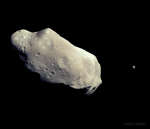
This asteroid has a moon. The robot spacecraft Galileo enroute to explore the Jovian system in 1993, encountered and photographed two asteroids during its long interplanetary voyage. The second minor planet it photographed, 243 Ida, was discovered to have a moon. Оценка: 5.0 [голосов: 1]
Очередной номер журнала "Небосвод" для любителей астрономии и от любителей астрономии Оценка: 5.0 [голосов: 1] |
|