Рейтинг публикаций
|
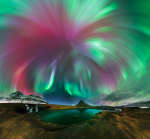
Cycle 25 solar maximum made 2025 a great year for aurora borealis (or aurora australis) on planet Earth. And the high level of solar activity should extend into 2026. So, while you're celebrating the arrival of the new year, check out this spectacular auroral display that erupted in starry night skies over Kirkjufell, Iceland. Оценка: 5.0 [голосов: 1]
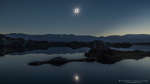
Если вы увидите полное солнечное затмение, хотели бы вы повторить его? Одному астрофотографу это удалось, но для этого потребовалось озеро и немного планирования. Понимая, что затмение будет видно низко над горизонтом, он стал искать... Оценка: 5.0 [голосов: 1]
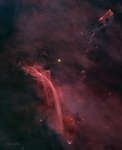
What created the Waterfall Nebula? The origin is still being researched. The structure, officially designated Herbig-Haro 222, appears in the region of NGC 1999 in the Great Orion Molecular Cloud complex. The elongated gaseous stream stretches about ten light years but appears similar to a long waterfall on Earth. Оценка: 5.0 [голосов: 1]
Здесь показана одна галактика или две? Кажется, что галактика только одна, однако правильный ответ – две. Такая картина может наблюдаться, когда маленькая галактика сталкивается с большой и оказывается в ее центре. Однако в этом случае происходит гораздо более редкое явление. Оценка: 5.0 [голосов: 1]
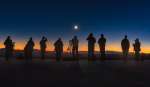
2 июля обитатели планеты Земля могли постоять в темной тени Луны во время полного солнечного затмения в Южной Америке. Затмение началось на юге Тихого океана, к востоку от Новой Зеландии. Узкая полоса затмения протянулась на восток, тень Луны вышла на сушу на побережье Чили, когда Солнце было низко над западным горизонтом. Оценка: 5.0 [голосов: 1]
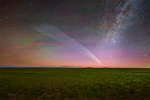
Yes, but can your comet tail do this? No, and what you are seeing is not the tail of a comet. The picture features a cleverly overlayed time-lapse sequence of a group of satellites orbiting Earth together in June. Оценка: 5.0 [голосов: 1]
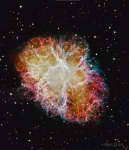
This is the mess that is left when a star explodes. The Crab Nebula, the result of a supernova seen in 1054 AD, is filled with mysterious filaments. The filaments are not only tremendously... Оценка: 5.0 [голосов: 1]
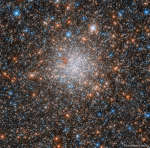
Jewels don't shine this bright -- only stars do. And almost every spot in this jewel-box of an image from the Hubble Space Telescope is a star. Now, some stars are more red than our Sun, and some more blue -- but all of them are much farther away. Оценка: 5.0 [голосов: 1]
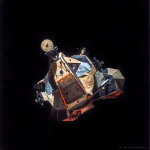
Awkward and angular looking, Apollo 17's lunar module Challenger was designed for flight in the near vacuum of space. Digitally enhanced and reprocessed, this picture taken from Apollo 17's command module America shows Challenger's ascent stage in lunar orbit. Оценка: 5.0 [голосов: 1]
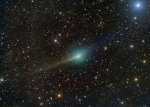
Attention grabbing interstellar visitor 3I/ATLAS made its not-so-close flyby of our fair planet on December 19 at a distance of 1.8 astronomical units. That's about 900 light-seconds. This deep exposure captures the comet... Оценка: 5.0 [голосов: 1] |
|