Рейтинг публикаций
|
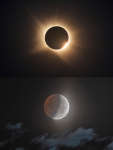
Eclipses tend to come in pairs. Twice a year, during an eclipse season that lasts about 34 days, Sun, Moon, and Earth can nearly align. Then the new and full phases of the Moon, separated by just over 14 days, create a solar and a lunar eclipse. Оценка: 5.0 [голосов: 1]
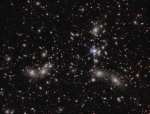
This deep field mosaicked image presents a stunning view of galaxy cluster Abell 2744 recorded by the James Webb Space Telescope's NIRCam. Also dubbed Pandora's Cluster, Abell 2744 itself appears to be a ponderous merger of three different massive galaxy clusters. It lies some 3.5 billion light-years away, toward the constellation Sculptor. Оценка: 5.0 [голосов: 1]
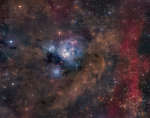
Young suns still lie within dusty NGC 7129, some 3,000 light-years away toward the royal constellation Cepheus. While these stars are at a relatively tender age, only a few million years old, it is likely that our own Sun formed in a similar stellar nursery around five billion years ago. Оценка: 5.0 [голосов: 1]
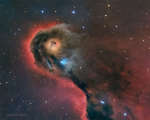
Is there a monster in IC 1396? Known to some as the Elephant's Trunk Nebula, parts of gas and dust clouds of this star formation region may appear to take on foreboding forms, some nearly human. The only real monster here, however, is a bright young star too far from Earth to hurt us. Оценка: 5.0 [голосов: 1]
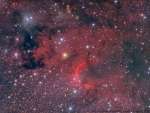
Этот цветной небесный пейзаж охватывает область размером около двух дисков полной Луны в богатом туманностями звездном поле около плоскости нашей Галактики Млечный Путь в северном созвездии Цефея. Яркая красноватая эмиссионная область Шарплесс 155, также известная как туманность Пещера, находится около края массивного молекулярного облака, удаленного на 2400 световых лет. Оценка: 5.0 [голосов: 1]
Эта бабочка может породить планеты. Туманность вокруг звезды IRAS 04302+2247 выглядит как крылья бабочки, а пересекающая центр вертикальная коричневая полоса – как тело бабочки, однако вместе они свидетельствуют об активном формировании планет. Изображение было недавно получено в инфракрасном диапазоне Космическим телескопом "Джеймс Вебб". В вертикальном диске много газа и пыли, из которых формируются планеты. Оценка: 5.0 [голосов: 1]
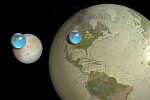
How much of Jupiter's moon Europa is made of water? No one is sure, but probably a lot. Based on the Galileo probe data acquired during its exploration of the Jovian system from 1995 to 2003, Europa possesses a deep, global ocean of liquid water beneath a layer of surface ice. Оценка: 5.0 [голосов: 1]
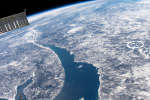
Orbiting 400 kilometers above Quebec, Canada, planet Earth, the International Space Station Expedition 59 crew captured this snapshot of the broad St. Lawrence River and curiously circular Lake Manicouagan on April 11, 2019. Right of center, the ring-shaped lake is a modern reservoir within the eroded remnant of an ancient 100 kilometer diameter impact crater. Оценка: 5.0 [голосов: 1]
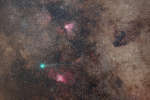
Comet C/2025 R2 (SWAN) sports a greenish coma and fainter tail, seen against congeries of stars and dusty interstellar clouds in this 7 degree wide telescopic field of view from October 17. On that... Оценка: 5.0 [голосов: 1]
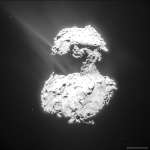
Where do comet tails come from? There are usually no obvious places on the nuclei of comets from which the jets that create comet tails emanate. One of the best images of emerging jets... Оценка: 5.0 [голосов: 1] |
|