Список публикаций
|
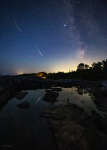
Known for its bright and fast meteors, the annual Perseid Meteor Shower comes to planet Earth's skies from a radiant in the heroic constellation Perseus. The popular northern summer celestial spectacle is created...
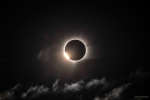
On August 12, the Moon's shadow reached out to touch our fair planet. Beginning in the Arctic Ocean, it swept along a narrow track that led the dark lunar umbra across parts of Greenland, Iceland, the Atlantic, Portugal, and northern Spain.
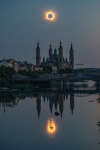
On August 12th, 2026, the Moon totally eclipsed the Sun and cast its shadow across Siberia, Greenland, Iceland, Spain, and Portugal. TodayБs image features two total solar eclipses viewed from Zaragoza, Spain, one over the Cathedral-Basilica of Our Lady of the Pillar and the other reflecting in the Ebro River.
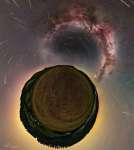
It looks like a view from the Little Prince's planet. The featured image is a throwback to the 2024 Perseid meteor shower, surrounded in this projection by the Bieszczady Mountains in Poland. Visible...
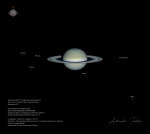
How many moons does Saturn have? While the total will likely continue to grow, as of June 2026 the ringed gas giant had 293 confirmed moons. That's easily more than any other planet of the Solar System, including ruling gas giant Jupiter with a mere 115 confirmed moons.
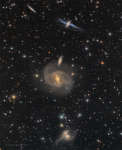
Each of these pairs of galaxies is different. The two galaxies at the top are likely not interacting, at least presently. However, the top galaxy with the blue stripe, NGC 4650A, is a polar ring galaxy and may be the result of a past galaxy collision.
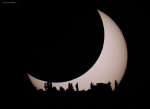
Рассматривали ли вы в последнее время ближайшую к нам звезду? На фотографии изображено Солнце, частично закрытое с левой верхней стороны Луной, а снизу – силуэтами землян, наблюдающих за солнечным затмением. Эти замечательные силуэты были...
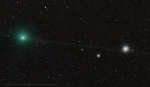
Какой из этих объектов – не комета? Вы угадали: справа – шаровое звездное скопление. Диффузная зеленоватая кома периодической кометы 10P/Темпель 2 видна в левой части картинки. Шаровое скопление – Мессье 30 (M30), или 30-й объект в каталоге "не комет" Шарля Мессье.
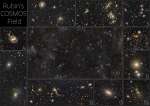
В центральном изображении этой картинки – более полумиллиона галактик. Это – поле COSMOS обсерватории имени Веры Рубин Национального научного фонда и Департамента энергетики в Чили. Первые изображения участка неба в несколько раз больше углового размера диска полной Луны были получены Космическим телескопом им.Хаббла. Затем его наблюдал телескоп "Джеймс Вебб" и другие телескопы.
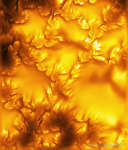
What does the new sharpest image of our Sun show? Instability. To be clear, a certain kind of interactive process called the Kelvin-Helmholtz instability (KHI). This instability can create waves and swirls when two streams flow past each other -- in this case variable streams of solar magnetic plasma. |
|