Список публикаций
за 2025 год.
|
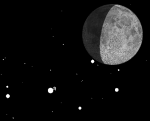
На данной неделе 27 января Луна (Ф= 0,69+) будет находиться близ Альдебарана, Урана и рассеянного звездного скопления Плеяды (покрытие при видимости в северной части восточной половины страны)
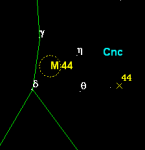
На данной неделе 24 января астероид Nysa (44) вступит в противостояние с Солнцем
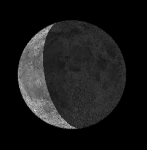
На данной неделе 13 января Луна (Ф= 0,21-) достигнет апогея своей орбиты на расстоянии 405437 км от центра Земли
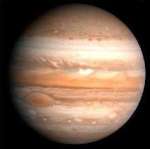
На данной неделе 10 января Юпитер вступит в противостояние с Солнцем, а Луна (Ф= 0,47-) пройдет близ Спики
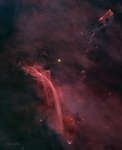
What created the Waterfall Nebula? The origin is still being researched. The structure, officially designated Herbig-Haro 222, appears in the region of NGC 1999 in the Great Orion Molecular Cloud complex. The elongated gaseous stream stretches about ten light years but appears similar to a long waterfall on Earth.
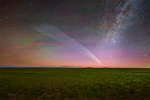
Yes, but can your comet tail do this? No, and what you are seeing is not the tail of a comet. The picture features a cleverly overlayed time-lapse sequence of a group of satellites orbiting Earth together in June.
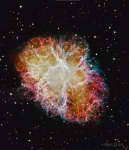
This is the mess that is left when a star explodes. The Crab Nebula, the result of a supernova seen in 1054 AD, is filled with mysterious filaments. The filaments are not only tremendously...
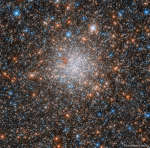
Jewels don't shine this bright -- only stars do. And almost every spot in this jewel-box of an image from the Hubble Space Telescope is a star. Now, some stars are more red than our Sun, and some more blue -- but all of them are much farther away.
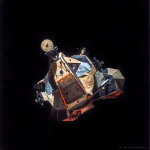
Awkward and angular looking, Apollo 17's lunar module Challenger was designed for flight in the near vacuum of space. Digitally enhanced and reprocessed, this picture taken from Apollo 17's command module America shows Challenger's ascent stage in lunar orbit.
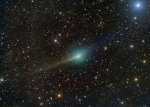
Attention grabbing interstellar visitor 3I/ATLAS made its not-so-close flyby of our fair planet on December 19 at a distance of 1.8 astronomical units. That's about 900 light-seconds. This deep exposure captures the comet... |
|