Список публикаций
за 2025 год.
|
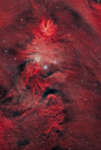
A star forming region cataloged as NGC 2264, this beautiful but complex arrangement of interstellar gas and dust is about 2,700 light-years distant in the faint but fanciful constellation Monoceros, the Unicorn. Seen...
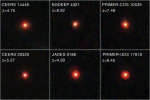
What are these little red dots (LRDs)? Nobody knows. Discovered only last year, hundreds of LRDs have now been found by the James Webb Space Telescope in the early universe. Although extremely faint, LRDs are now frequently identified in deep observations made for other purposes.
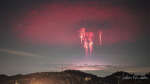
What's happening in the sky? Lightning. The most commonly seen type of lightning involves flashes of bright white light between clouds. Over the past 50 years, though, other types of upper-atmospheric lightning have been confirmed, including tentacled red sprites and ringed ELVES.
Yesterday the Sun reached its southernmost point in planet Earth's sky. Called a solstice, many cultures mark yesterday's date as a change of seasons -- from autumn to winter in Earth's Northern Hemisphere and from spring to summer in Earth's Southern Hemisphere.
What are those colorful rings around the Moon? A corona. Rings like this will sometimes appear when the Moon is seen through thin clouds. The effect is created by the diffraction of light around individual, similarly-sized water droplets in an intervening but mostly transparent cloud.
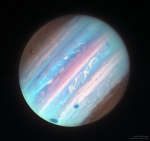
Jupiter looks a bit different in ultraviolet light. To better interpret Jupiter's cloud motions and to help NASA's robotic Juno spacecraft understand the planetary context of the small fields that it sees, the Hubble Space Telescope was being directed to regularly image the entire Jovian giant.
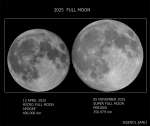
What was so super about Wednesday's supermoon? Last week, a full moon occurred that appeared slightly larger and brighter than usual. The reason is that the Moon's fully illuminated phase occurred within a short time from perigee - when the Moon was its closest to the Earth in its elliptical orbit.
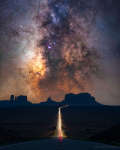
Does the road to our galaxy's center go through Monument Valley? It doesn't have to, but if your road does -- take a picture. In this case, the road is US Route 163 and iconic buttes on the Navajo National Reservation populate the horizon.
What is big, bright, and beautiful, can wear a cape made of clouds, and is at the closest point in its elliptical orbit around planet Earth? A full moon at perigee of course, captured here near moonset in predawn skies on November 5 from Kayseri, Turkiye.
Spanning light-years, this suggestive shape known as the Seahorse Nebula floats in silhouette against a rich background of stars and glowing hydrogen gas. Seen toward the royal northern constellation of Cepheus, the dusty, dark nebula is part of a Milky Way molecular cloud some 1,200 light-years distant. |
|