
|
APOD: 2026 February 16 Б Unexplained Shocks Around a White Dwarf Star
| << Yesterday | 15.02.2026 | Tomorrow >> |

Credit & Copyright: ESO,
K. Iеkiewicz &
S. Scaringi
et al.;
Text: Cecilia Chirenti (NASA GSFC, UMCP, CRESST II)
Explanation:
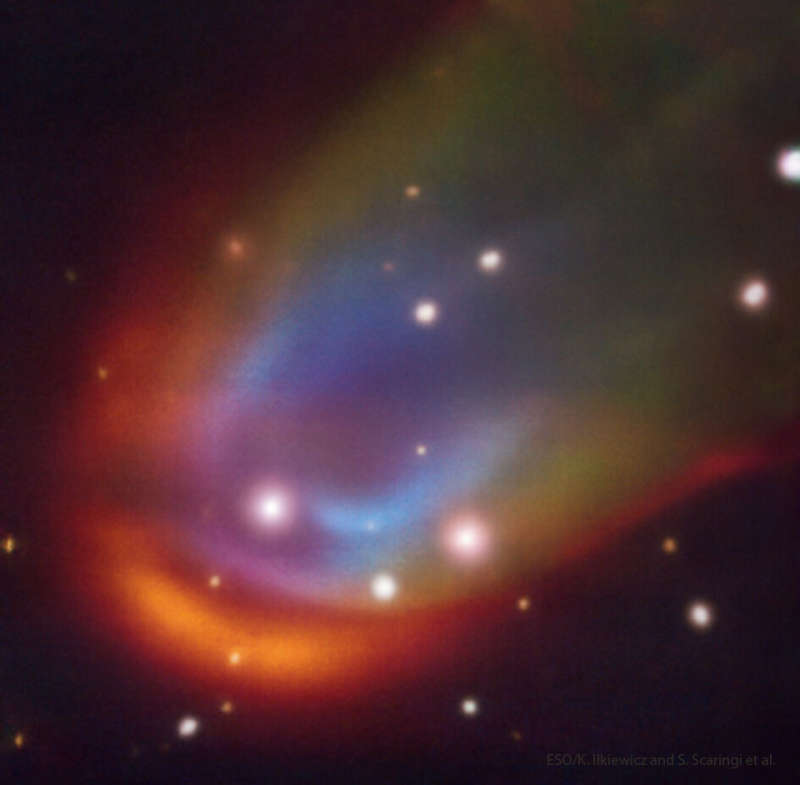
How is RXJ0528+2838 creating such shock waves?
A recently discovered
white dwarf star,
the farther left of the two largest white spots,
RXJ0528+2838,
was found 730
light-years away from
Earth.
Most stars, when
done fusing nuclei in their cores for energy, become
red giant stars, the cores of which
live on as faint dense
white dwarfs that slowly cool down for the rest of time.
White dwarfs are so dense that the
only thing that stops them from collapsing further is
quantum mechanics.
In about 5 billion years,
our Sun will become a
white dwarf, too.
The featured image, obtained with the
European Southern ObservatoryБs
Very Large Telescope, shows unexplained
bow shocks around RXJ0528+2838, similar to the
bow wave of water around a fast-moving ship.
Astronomers
donБt yet know what is powering
these shocks, which have existed for at least 1,000 years.
The red, green and blue colors represent trace amounts of glowing
hydrogen,
nitrogen and
oxygen gas.
Text: Cecilia Chirenti (NASA GSFC, UMCP, CRESST II)
Open Science:
Browse 3,900+ codes in the Astrophysics Source Code Library
|
January February March April May June July August |
| ||||||||||||||||||||||||||||||||||||||||||||||||
NASA Web Site Statements, Warnings, and Disclaimers
NASA Official: Jay Norris. Specific rights apply.
A service of: LHEA at NASA / GSFC
& Michigan Tech. U.
Based on Astronomy Picture
Of the Day
Publications with keywords: white dwarf
Publications with words: white dwarf
See also: