
|
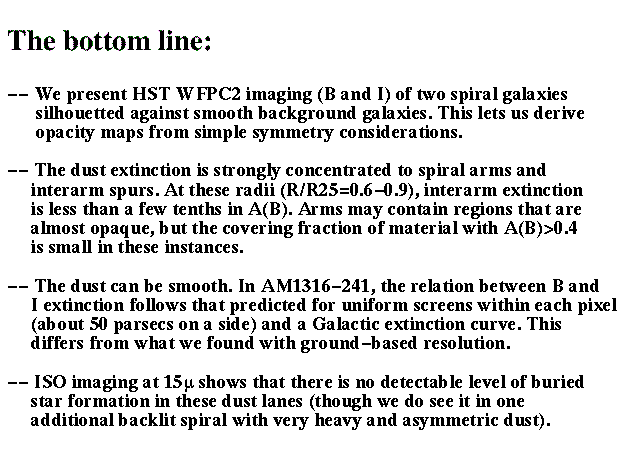
Explanation: How much dust is in spiral galaxies? Does it block out much of the starlight? Because astronomers rely on an accurate knowledge of galaxy properties to investigate a wide range of problems, like galaxy and quasar evolution and the nature of dark matter, answers to simple questions like this are key. This striking, detailed Hubble Space Telescope image of dust in the outer reaches of a foreground spiral galaxy (left) back lit by an elliptical galaxy offers an elegant approach to providing the answers. As expected, dust lanes in the foreground galaxy seem to be associated with spiral arms. But surprisingly, many dust regions are not completely opaque and the dust is more smoothly distributed than anticipated. This "overlapping" pair of galaxies is cataloged as AM1316-241 and is about 400 million light-years away in the constellation Hydra.

|
January February March April May June July August September October November December |
| ||||||||||||||||||||||||||||||||||||||||||||||||
NASA Web Site Statements, Warnings, and Disclaimers
NASA Official: Jay Norris. Specific rights apply.
A service of: LHEA at NASA / GSFC
& Michigan Tech. U.
Based on Astronomy Picture
Of the Day
Publications with keywords: dust - spiral galaxy
Publications with words: dust - spiral galaxy
See also:
- APOD: 2026 August 30 Б M74: A Grand Design Spiral
- APOD: 2026 July 22 Б The Corona Australis Cloud and the Chandelier Cluster
- NGC 300: A Cosmic Gemstone with Stars and Gas Clouds
- APOD: 2026 July 9 Б The Red Glow of the Cosmic Bat Nebula
- APOD: 2026 May 29 Б Messier 104
- APOD: 2026 April 5 Б NGC 3310: A Starburst Spiral Galaxy
- APOD: 2026 March 16 Б NGC 1566: The Spanish Dancer Galaxy