
|
Astronomy Picture Of the Day (APOD)
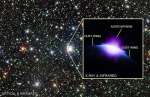 APOD: 2026 March 6 Б The Astrosphere of HD 61005
6.03.2026
Do young stars blow bubbles? The larger view shows a stellar field observed with the Cerro Tololo Inter-American Observatory in Chile, and the inset highlights HD 61005, a star like our Sun, only 120 light-years away.
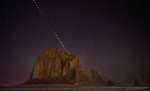 APOD: 2026 March 5 Б Total Lunar Eclipse over Tse Bitai
5.03.2026
Earlier this week, EarthБs shadow swept across the full Moon in the yearБs only total lunar eclipse. This stunning sequence combines images showing the MoonБs path across the night sky. Each lunar image captures our planetБs shadow gradually engulfing the Moon, culminating in its red glow.
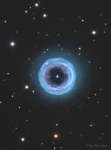 APOD: 2026 March 4 Б Shapley 1: An Annular Planetary Nebula
4.03.2026
WhatБs looking back at you isnБt a cosmic eye, but Shapley 1, a beautifully symmetric planetary nebula. Shapley 1, also known as the Fine Ring Nebula or PLN 329+2.1, bejewels the southern sky constellation of the Carpenter's Square (Norma).
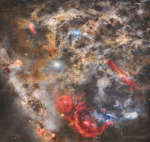 APOD: 2026 March 2 Б The Dusty Surroundings of Orion and the Pleiades
2.03.2026
How well do you know the night sky? OK, but how well can you identify famous sky objects in a very deep image? Either way, here is a test: see if you can find some well-known night-sky icons in a deep image filled with filaments of normally faint dust and gas.
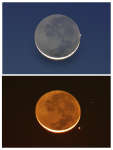 Lunar Occultation of Mercury
28.02.2026
Fans of the western sky after sunset have lately enjoyed this month's remarkable array of bright planets. Witnessed from some locations, on February 18 planet Mercury even appeared to slide behind the Moon, an event known as a lunar occultation.
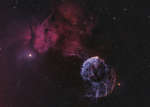 Sharpless 249 and the Jellyfish Nebula
27.02.2026
Normally faint and elusive, the Jellyfish Nebula is caught in this alluring telescopic field of view. Floating in the interstellar sea, the nebula is anchored right and left by two bright stars, Mu and Eta Geminorum, at the foot of the celestial twins.
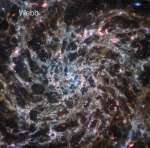 Webb and Hubble: IC 5332
26.02.2026
What does the universe look like through infrared goggles? Our eyes can only see visible light, but astronomers want to see more. TodayБs APOD shows spiral galaxy IC 5332 as seen by two NASA telescopes: Webb in mid-infrared and Hubble in ultraviolet and visible light.
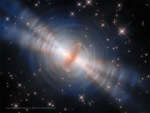 APOD: 2026 February 25 Б The Egg Nebula from the Hubble Telescope
25.02.2026
Ever wonder what it would look like to crack open the Sun? The Egg Nebula, a dying Sun-like star, can unscramble this question. Pictured is a combination of several visible and infrared images of the nebula (also known as RAFGL 2688 or CRL 2688) taken with the Hubble Space Telescope.
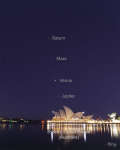 APOD: 2026 February 24 Б Planet Parade over Sydney Opera House
24.02.2026
Look up this week and see a whole bunch of planets. Just after sunset, looking west (mostly), planets Mercury, Venus, Saturn, and Jupiter will all be visible to the unaided eye simultaneously. If you have a telescope, planets Uranus and Neptune can also be seen.
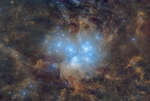 APOD: 2026 February 23 Б Pleiades: The Seven Sisters Star Cluster
23.02.2026
Have you ever seen the Pleiades star cluster? Even if you have, you probably have never seen it as large and clear as this. Perhaps the most famous star cluster on the sky, the bright stars of the Pleiades can be seen with the unaided eye even from the depths of a light-polluted city.
|
January February March |
||||||||||||||||||||||||||||||||||||||||||||||||||||||||