Рейтинг публикаций
за октябрь 2025 года.
|
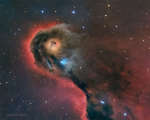
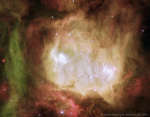
Is there a monster in IC 1396? Known to some as the Elephant's Trunk Nebula, parts of gas and dust clouds of this star formation region may appear to take on foreboding forms, some nearly human. The only real monster here, however, is a bright young star too far from Earth to hurt us. Оценка: 5.0 [голосов: 1]
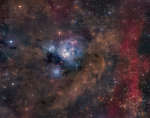
Young suns still lie within dusty NGC 7129, some 3,000 light-years away toward the royal constellation Cepheus. While these stars are at a relatively tender age, only a few million years old, it is likely that our own Sun formed in a similar stellar nursery around five billion years ago. Оценка: 5.0 [голосов: 1]
Where do comet tails come from? There are usually no obvious places on the nuclei of comets from which the jets that create comet tails emanate. One of the best images of emerging jets... Оценка: 5.0 [голосов: 1]
What electrifies the Heart Nebula? First, the large emission nebula on the left, catalogued as IC 1805, looks somewhat like a human heart. The nebula glows brightly in red light emitted by its most prominent element, hydrogen, but this long-exposure image was also blended with light emitted by sulfur (yellow) and oxygen (blue). Оценка: 5.0 [голосов: 1]
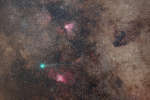
Comet C/2025 R2 (SWAN) sports a greenish coma and fainter tail, seen against congeries of stars and dusty interstellar clouds in this 7 degree wide telescopic field of view from October 17. On that... Оценка: 5.0 [голосов: 1]
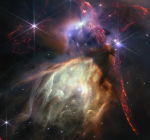
A mere 390 light-years away, Sun-like stars and future planetary systems are forming in the Rho Ophiuchi molecular cloud complex, the closest star-forming region to our fair planet. The James Webb Space Telescope's NIRCam peered into the nearby natal chaos to capture this infrared image at an inspiring scale. Оценка: 5.0 [голосов: 1]
Halloween's origin is ancient and astronomical. Since the fifth century BC, Halloween has been celebrated as a cross-quarter day, a day halfway between an equinox (equal day / equal night) and a solstice (minimum day / maximum night in the northern hemisphere). Оценка: 5.0 [голосов: 1]
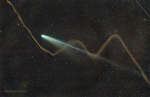
How many bright tails does Comet Lemmon have? Two. In the featured image it appears to have three, but why? The reason is that the zigzagging brown filament is a persistent meteor train that by luck appeared in front of the distant comet C/2025 A6 (Lemmon). Оценка: 5.0 [голосов: 1]
Can you see the bat? It haunts this cosmic close-up of the eastern Veil Nebula. The Veil Nebula itself is a large supernova remnant, the expanding debris cloud from the death explosion of a massive star. Оценка: 5.0 [голосов: 1]
Очередной выпуск ежемесячника, освещающего астрономические явления и небесные тела, доступные для наблюдений невооруженным глазом и любительскими оптическими средствами Оценка: 5.0 [голосов: 1] |
|