Рейтинг публикаций
за октябрь 2025 года.
|
Очередной выпуск ежемесячника, освещающего астрономические явления и небесные тела, доступные для наблюдений невооруженным глазом и любительскими оптическими средствами Оценка: 5.0 [голосов: 5]
Журнал "Небосвод" для любителей астрономии Оценка: 5.0 [голосов: 4]
Журнал "Небосвод" для любителей астрономии Оценка: 5.0 [голосов: 3]
Десять тысяч лет назад, во времена, от которых не осталось письменных свидетельств на Земле, в ночном небе внезапно вспыхнула новая звезда. Через несколько недель она погасла. Это взорвалась сверхновая звезда. Расширяющееся облако газа, которое от нее осталось, называется туманностью Вуаль. Оценка: 5.0 [голосов: 2]
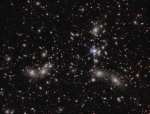
This deep field mosaicked image presents a stunning view of galaxy cluster Abell 2744 recorded by the James Webb Space Telescope's NIRCam. Also dubbed Pandora's Cluster, Abell 2744 itself appears to be a ponderous merger of three different massive galaxy clusters. It lies some 3.5 billion light-years away, toward the constellation Sculptor. Оценка: 5.0 [голосов: 1]
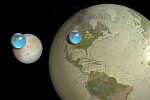
How much of Jupiter's moon Europa is made of water? No one is sure, but probably a lot. Based on the Galileo probe data acquired during its exploration of the Jovian system from 1995 to 2003, Europa possesses a deep, global ocean of liquid water beneath a layer of surface ice. Оценка: 5.0 [голосов: 1]
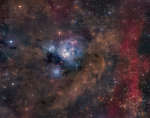
Young suns still lie within dusty NGC 7129, some 3,000 light-years away toward the royal constellation Cepheus. While these stars are at a relatively tender age, only a few million years old, it is likely that our own Sun formed in a similar stellar nursery around five billion years ago. Оценка: 5.0 [голосов: 1]
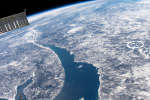
Orbiting 400 kilometers above Quebec, Canada, planet Earth, the International Space Station Expedition 59 crew captured this snapshot of the broad St. Lawrence River and curiously circular Lake Manicouagan on April 11, 2019. Right of center, the ring-shaped lake is a modern reservoir within the eroded remnant of an ancient 100 kilometer diameter impact crater. Оценка: 5.0 [голосов: 1]
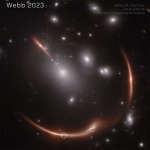
Now a second supernova in this same galaxy is repeating. The cause is the gravitational lens effect of a massive foreground cluster of galaxies (MACS J0138) -- it creates multiple images of a perfectly aligned background galaxy (MRG-M0138). What's particularly interesting is that this background galaxy has young stars that keep blowing up. Оценка: 5.0 [голосов: 1]
Очередной выпуск ежемесячника, освещающего астрономические явления и небесные тела, доступные для наблюдений невооруженным глазом и любительскими оптическими средствами Оценка: 5.0 [голосов: 1] |
|