Рейтинг публикаций
за декабрь 2025 года.
|
Когда на Луне наступает фаза первой четверти, Солнце восходит над Кавказскими горами на лунной поверхности. Лунные горы отбрасывают эффектные остроконечные тени, запечатленные на этом телескопическом изображении лунного терминатора, или границы между днем и ночью. Высота лунных Кавказских гор, названных в честь земных гор, достигает 6 километров. Оценка: 5.0 [голосов: 1]
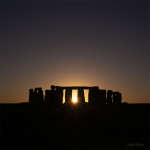
Английское слово "solstice" (солнцестояние) составлено из латинских слов "солнце" и "стояние". В дни около солнцестояния ежегодное перемещение Солнца с севера на юг на небе планеты Земля замедляется, останавливается и меняет направление. В это время дневной путь Солнца по небу почти не изменяется. Оценка: 5.0 [голосов: 1]
Yesterday the Sun reached its southernmost point in planet Earth's sky. Called a solstice, many cultures mark yesterday's date as a change of seasons -- from autumn to winter in Earth's Northern Hemisphere and from spring to summer in Earth's Southern Hemisphere. Оценка: 5.0 [голосов: 1]
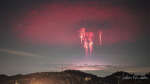
What's happening in the sky? Lightning. The most commonly seen type of lightning involves flashes of bright white light between clouds. Over the past 50 years, though, other types of upper-atmospheric lightning have been confirmed, including tentacled red sprites and ringed ELVES. Оценка: 5.0 [голосов: 1]
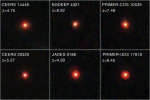
What are these little red dots (LRDs)? Nobody knows. Discovered only last year, hundreds of LRDs have now been found by the James Webb Space Telescope in the early universe. Although extremely faint, LRDs are now frequently identified in deep observations made for other purposes. Оценка: 5.0 [голосов: 1]
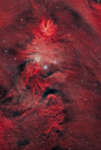
A star forming region cataloged as NGC 2264, this beautiful but complex arrangement of interstellar gas and dust is about 2,700 light-years distant in the faint but fanciful constellation Monoceros, the Unicorn. Seen... Оценка: 5.0 [голосов: 1]
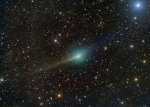
Attention grabbing interstellar visitor 3I/ATLAS made its not-so-close flyby of our fair planet on December 19 at a distance of 1.8 astronomical units. That's about 900 light-seconds. This deep exposure captures the comet... Оценка: 5.0 [голосов: 1]
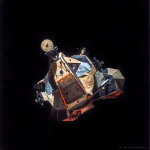
Awkward and angular looking, Apollo 17's lunar module Challenger was designed for flight in the near vacuum of space. Digitally enhanced and reprocessed, this picture taken from Apollo 17's command module America shows Challenger's ascent stage in lunar orbit. Оценка: 5.0 [голосов: 1]
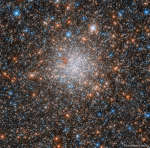
Jewels don't shine this bright -- only stars do. And almost every spot in this jewel-box of an image from the Hubble Space Telescope is a star. Now, some stars are more red than our Sun, and some more blue -- but all of them are much farther away. Оценка: 5.0 [голосов: 1]
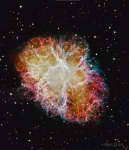
This is the mess that is left when a star explodes. The Crab Nebula, the result of a supernova seen in 1054 AD, is filled with mysterious filaments. The filaments are not only tremendously... Оценка: 5.0 [голосов: 1] |
|